
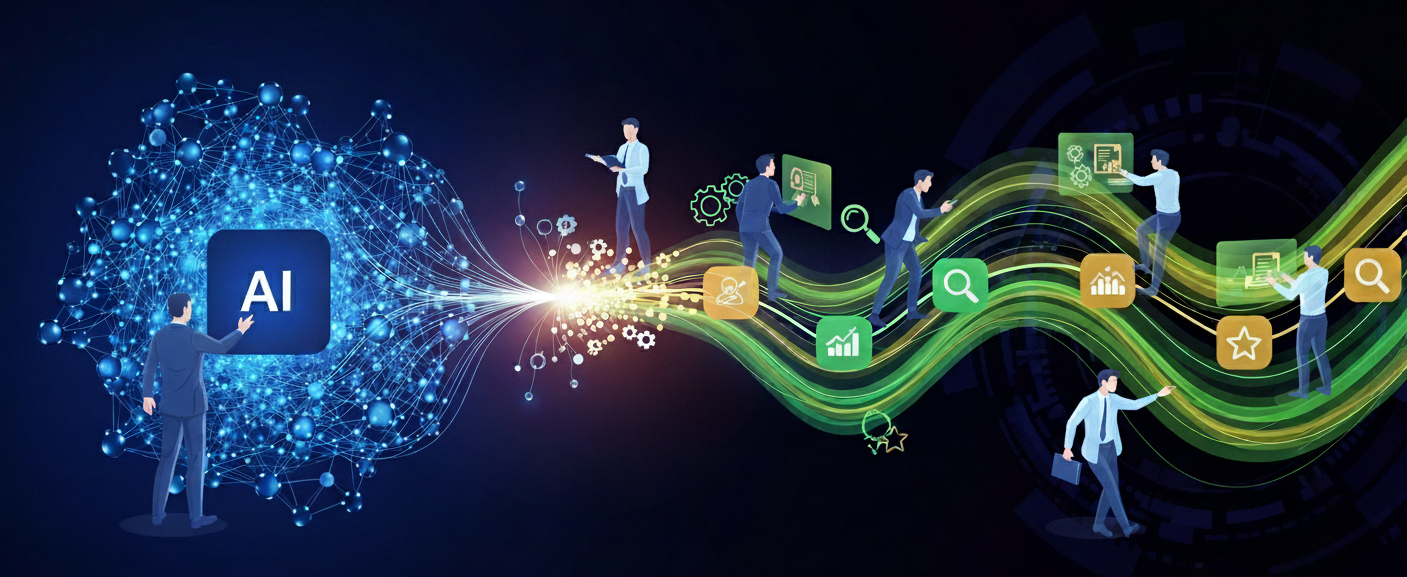
The sales numbers are in, and they’re disappointing. In the boardroom, the post-mortem is underway, and the consensus is clear: the problem lies not with the product, but with our communication. Our messages are failing to resonate; they’re slow to market, lack innovation, and aren’t reaching the right people. This is a common story in businesses around the world. Faced with this challenge, there are two distinct paths you can take to fix the problem. One is the familiar, traditional route. The other is a revolutionary AI-led workflow, powered by a new kind of intelligent system: the AI Agent.
The traditional workflow, while well-established, is a multi-step, fragmented process. It begins with a meeting, often a long one. You brief a marketing agency on your sales problem, providing them with a creative brief. This is followed by a period of waiting as the agency develops a creative solution. Weeks might pass as they strategize, brainstorm, and present concepts. Once a creative direction is approved, the baton is passed to content developers who craft a detailed content strategy. This strategy is then handed off to a team of copywriters, photographers, and graphic designers who create the communication assets—the words, images, and videos.
With the assets in hand, the agency’s media buyers define a budget and start the arduous process of media planning and placement. They negotiate with traditional media outlets, from newspapers and magazines to television and radio stations, as well as digital platforms. At each stage, there are approvals, revisions, and delays. Finally, months after the initial sales review, the campaign goes live. The process is a long relay race, with each team member dependent on the previous one’s output. It’s a method built for a pre-digital era, where speed was a luxury and personalization was limited to broad demographic targeting.
Now, imagine approaching this same problem with a different mindset. You ask an AI chatbot how AI might approach it, and it rolls out a concept you’ve never heard of before: the AI Agent.
An AI Agent is far more than a simple chatbot or a tool that helps you write a draft email. It is a goal-oriented, autonomous system designed to plan, execute, and adapt an entire workflow to achieve a specific objective. You don’t brief an agency; you brief the agent.
The AI-Led Workflow: A Step-by-Step Breakdown
Here’s how an AI-led process, powered by an AI Agent, would unfold to solve your communication problem:
Step 1: Define the Goal, Not the Process. Instead of providing a creative brief with a long list of deliverables, you simply define the objective. You tell the AI Agent: “Our goal is to increase sales by 10% by improving our communication.” The AI Agent is then tasked with autonomously figuring out the best way to achieve that. This shifts the focus from managing tasks to defining outcomes.
Step 2: Data-Driven Diagnosis and Strategy. The AI Agent’s first action is to access and analyse the data you’ve already accumulated from your digital transformation. It doesn’t need to wait for a research team. It instantly sifts through website analytics, customer relationship management (CRM) data, social media engagement, and past campaign performance. It identifies patterns, segments your audience, and builds detailed profiles of who your customers are, what content they respond to, and their online behaviours. That might discover that a specific demographic responds best to video content on Instagram Reels on weekday evenings. The agent doesn’t guess; it knows.
Step 3: Automated, Hyper-Personalized Content Creation. Based on its analysis, the AI Agent uses generative AI models to create a massive volume of highly personalized content. It’s not just one message for one audience. The agent can produce thousands of variations of ad copy, social media posts, email subjects, and website banners, each one tailored to a specific audience segment. This eliminates the traditional back-and-forth with copywriters and designers, accelerating the process from weeks to hours.
Step 4: AI-Driven Review and Iteration. This is where a crucial new layer of intelligence comes into play. The AI Agent doesn’t simply publish the content it creates. It sends the generated copy and visuals to a second AI model, which acts as a predictive validator. This second model, trained on historical data and success metrics, simulates the expected performance of each piece of content. It predicts which ad copy will generate the most clicks or which image will lead to the highest conversion rate. If a piece of content is flagged as having low potential, the first generative AI model is sent back to the drawing board to create a new, refined version. This process of creation and validation is repeated in a rapid loop until the AI models agree on a set of communications that are predicted to deliver success. .
Step 5: Dynamic Media Placement and Optimization. The AI Agent doesn’t just hand off a media plan. It actively manages the entire media placement process in real-time. It connects to advertising platforms and automatically identifies the most effective channels—be it Google Ads, Facebook, LinkedIn, or a niche blog. The agent doesn’t just place ads; it dynamically adjusts bids, budgets, and targeting criteria minute by minute based on live performance data. If an ad on a particular platform isn’t performing well, the AI agent automatically shifts the budget to a more effective channel or tests a different variation of the ad, all without human intervention. This continuous optimization ensures every rand spent is working as hard as possible.
Step 6: Continuous Learning and Adaptation. The traditional workflow is largely static once the media is placed. An AI Agent, however, operates in a constant feedback loop. It’s an intelligent system that learns from every interaction. Every click, conversion, and bounce is data that the agent uses to refine its strategy. It automatically identifies new trends, changes in audience behavior, and shifts in the competitive landscape, adjusting its approach accordingly. This self-improving cycle ensures your communication strategy is always at the cutting edge, long after a traditional campaign would have concluded.
The Advantages of the AI Agent Approach
The advantages of this AI-led process are profound and directly address the core business priorities of speed, cost, and quality.
- Speed: The AI Agent collapses a multi-month workflow into a matter of days or even hours. The instant analysis, automated content creation, and real-time optimization eliminate the lengthy delays inherent in a human-centric, multi-team process.
- Efficiency and Cost-Effectiveness: The AI Agent is relentless in its pursuit of efficiency. It eliminates human labour on repetitive tasks, and its continuous optimization ensures that media spend is always directed towards the highest-performing channels. This leads to a lower cost per acquisition and a significantly higher return on investment.
- Hyper-Personalization and Quality: The AI Agent’s ability to analyse vast datasets and create thousands of tailored content variations means your messages are no longer generic. They are hyper-personalized and delivered with a level of precision that is impossible for a human team to achieve. The built-in AI review step ensures that the content published is already pre-validated, leading to a higher quality of engagement and, ultimately, better sales results.
This isn’t just about using a new tool; it’s about fundamentally rethinking how work gets done. It’s a shift from a linear, human-dependent workflow to an integrated, autonomous, and continuously optimizing system. The AI Agent represents the next evolution of digital transformation, proving that a focus on smarter, more efficient workflows is the true key to unlocking business success. It’s not about having an AI tool; it’s about entrusting the entire campaign workflow to a digital agent designed for continuous improvement and tangible results.
About Garth Sutherland
You’re a busy business owner, not a marketing manager. Your focus is on customers and operations, not wrestling with complex marketing strategies. That’s where I come in.
I’m Garth Sutherland, and with vast experience in the marketing solutions available to small businesses, I truly understand what it takes to drive growth. My background, spanning both local and international brands, has equipped me with a strong strategic focus for marketing delivery. I know you need action and results, not just elaborate plans.
If the insights shared in my blog (and others at www.smallbusinessmarketing.co.za) resonate with you and highlight a solution that would add tangible value to your business, then you’re in the right place. As a fractional marketing consultant, I don’t just develop actionable marketing plans; I crucially manage their execution. This frees you up to do what you do best: build your business, without the added overwhelm.
Ready to achieve your personal and business goals, and reclaim your valuable time?
Contact me, Garth Sutherland, today for a direct conversation about your growth challenges:
Email: garth@smallbusinessmarketing.co.za
LinkedIn: https://www.linkedin.com/in/garthrsutherland/
Call: +27 (0) 81 265 5803
Leave a Reply