
Every ambitious B2B business owner knows that consistent, high-quality written content is the gold standard for building trust, showing off expertise, and winning high-value clients. If you aren’t writing, you’re invisible. In today’s competitive landscape, showing up with authority is no longer optional—it is how you win.
But you face a massive hurdle: time. You are busy running a business. You do not have four hours to sit down, stare at a blank screen, and draft a blog post.
You have probably tried using AI tools to solve this. But if you’ve ever hit “generate” on a generic tool, you know the result: a boring, generic, and obviously machine-written wall of text. It lacks your unique business insight, sounds incredibly robotic, and risks damaging your professional reputation.
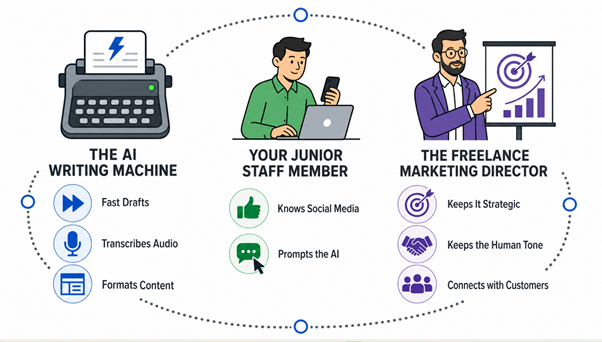
The solution isn’t to stop writing. It is to change how you write. By setting up a simple, three-part team, you can produce highly authoritative B2B content consistently, using an affordable, semi-automated process that takes the entire burden off your shoulders.
The Trio: Your High-Output Content Team
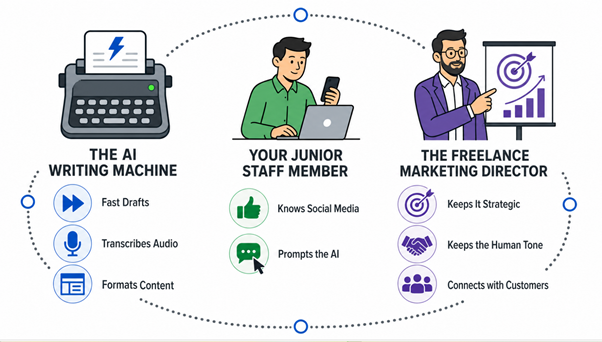
By combining a low-cost internal staff member, a flexible freelance strategist, and smart technology, you build a content engine that runs on autopilot.
Here is how the team is structured:
Step 1: Put a Junior Organizer in Charge
To make this work, you need someone internally to own the process and chase deadlines. This does not require a highly paid manager. A junior staff member, an administrative assistant, or even an intern is perfect.
Their job is to be the “project manager” of your content:
- Process Ownership: They keep the train on the tracks, schedule sessions, and ensure draft deadlines are met.
- The Growth Curve: Best of all, by working directly alongside a seasoned freelance marketer, this junior staff member gets real-world, high-level training on the job. Over time, they will need less supervision, meaning your freelance costs will decrease as your internal team grows more capable.
Step 2: Build a Real-World Content Calendar
Your junior organizer’s first task is to set up a simple calendar. Don’t let them sit in a corner trying to invent academic topics. Instead, have them gather simple inputs from the people who talk to your customers every day—your sales and customer service teams.
Have your junior staffer ask them one simple question: “What are the top five questions customers asked us this week?”
Answering these exact questions in your articles ensures your content is immediately useful, highly relevant, and directly addresses the real pain points of your target B2B market.
Step 3: The Strategy Session (Where the Freelance Director Adds Value)
Once you have your topics, your junior staff member sits down for a brief session with your Freelance Marketing Director. This is where the magic happens, and it’s where you get senior-level corporate brainpower without the heavy full-time salary.
During this session, the freelance director:
- Aligns Content to Sales Goals: They make sure you aren’t just writing “for the sake of writing”. They tie the topic directly to a business objective, like generating leads for a specific service.
- Designs the Prompts: They outline the core arguments and decide exactly how to prompt the AI to get a deep, industry-specific draft rather than surface-level fluff.
Step 4: From Fast Drafts to Perfect Polish
Now, the production line moves:
- The Machine Churns: Your junior staff member feeds the strategic prompts and any raw notes or audio transcriptions into the AI. Within minutes, the AI produces a structured, complete draft.
- The Human Polish: This rough draft is handed over to the Freelance Marketing Director. They edit the text, inject real-world anecdotes, correct the flow, and ensure it sounds 100% human, authoritative, and perfectly aligned with your brand’s unique tone of voice.
Step 5: Getting the Word Out (Your Multi-Channel Campaign)
Writing the article is only 20% of the battle. The other 80% is distribution. Once your authoritative piece is polished, your junior staffer and freelance director turn that single article into an entire month’s marketing campaign.
Here is how you turn one blog post into a multi-channel blitz:
1. Turn It Into an Audio Podcast (In 5 Minutes)
You don’t need a professional recording studio, a sound engineer, or even your own microphone to have a podcast.
- The Tool: Use advanced AI voice generators like ElevenLabs or NotebookLM.
- How it works: Your junior staff member uploads your finished, polished article. Within minutes, these tools can generate an incredibly realistic, human-sounding audio version of your blog—or even a dynamic, two-person “radio talk show” style discussion of your article.
- The Result: You host this on your site or upload it to Spotify as a quick-hit B2B podcast for busy clients who prefer to listen on their commute.
2. Run a 4-Week LinkedIn Campaign
Never just post a link to your blog once and hope for the best. Instead, carve the article up into a structured, month-long social campaign:
- Week 1 (The Hook): Share a bold, contrarian opinion or a key statistic from the article in a text-only post.
- Week 2 (The Visual): Have your junior staffer use a simple design tool like Canva to turn the main points into an easy-to-read 5-slide PDF carousel.
- Week 3 (The Actionable Tip): Post one specific, highly practical “how-to” step taken directly from the middle of the article.
- Week 4 (The Case Study/Story): Share a brief, real-world story or anecdote that proves the article’s main point.
3. Take Over WhatsApp and Direct Messaging
In B2B, some of your highest-value relationships aren’t reading blogs or checking LinkedIn every day—but they are on their phones.
- The Tactic: Do not spam group chats. Instead, have your junior staffer draft a highly personalized, one-sentence message for you to send directly to your top 10 warmer leads or past clients.
- The Script: “Hey [Name], I recently wrote a piece on how B2B companies are cutting down content creation time. I know you’ve been busy, so I thought this might be useful for you. Let me know what you think!”
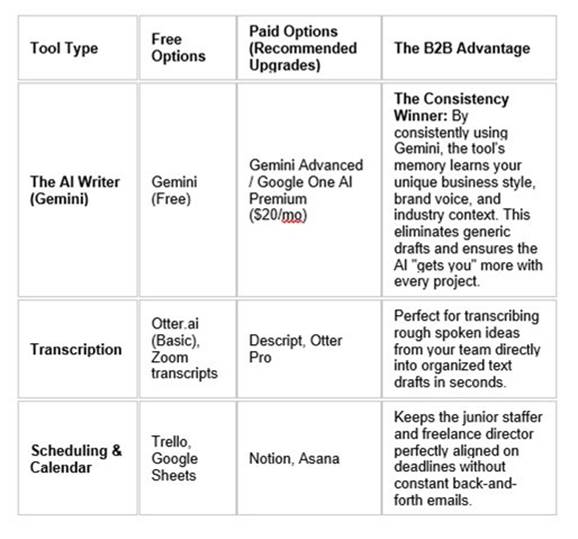
What Tools Do You Actually Need?
Pro-Tip: Stick to One Tool So It “Gets” Your Business
The secret to great AI output is consistency. If you bounce around different platforms, you start from scratch every time. Stick to one tool—like Gemini—and let its memory feature store your target audience, core business objectives, and brand voice. Over time, your junior staffer won’t just be prompting a machine; they will be prompting a virtual assistant that speaks fluent “you.”
The Bottom Line: Writing the Blog is Just the Starting Gun
The day your blog post is published is not the end of the project—it is the beginning. It is in the distribution and the creative posting where you actually win the market.
This is precisely where having a Freelance Marketing Director is invaluable. While a junior staff member can run the daily tools, a freelance strategist has a million creative ways to squeeze every drop of value out of a single piece of content. They will guide your team on:
- Which local B2B portals or industry-specific forums to share the article in.
- How to turn the blog into a direct email marketing campaign that actually gets opened.
- How to use the content to warm up cold sales leads before your sales team even makes a call.
With this three-part team, you don’t just write—you dominate. You build a highly authoritative, visible B2B business, upskill your internal staff, and free up your own time to do what you do best: run a winning business.
Leave a Reply