
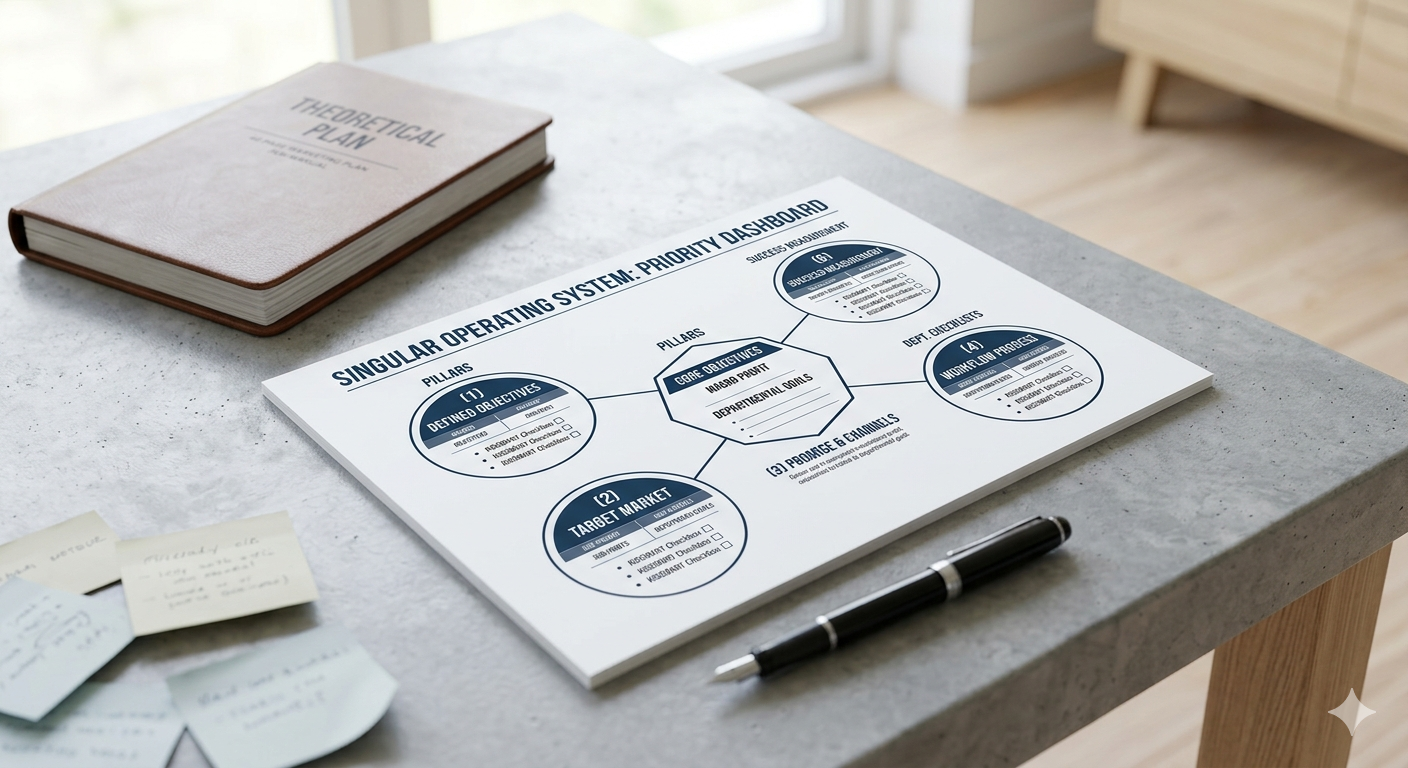
The daily pain of ownership is an exhausting cycle of talking about your business over and over again, only to find that nothing actually changes. You know your team understands what they need to do because you have told them countless times, yet when you check in, they remain vague, as if the instructions never existed. You are stuck in a loop of constant supervision, feeling like you are the only one holding the business up because your vision remains locked in your head, rather than being a visible, shared responsibility.
You feel that if you write it down, it will only become another 40-page theoretical plan that no one reads—but the answer isn’t ‘more’ communication; it is different communication. You do not need a volume of rules; you need a Priority Dashboard, that serves as a central communication view. This is not a plan meant for a shelf; it is a live, one-page tool that turns your objectives into specific, daily departmental checklists. By making this visual and concise, you stop being the only person holding the load, and your team stops being ‘order takers,’ becoming instead ‘Communication Responsibles’ who see exactly how their daily output drives the profit you set out to achieve.
Objectives are the Foundation of Profit
Every business sets its objectives based on the experience, vision, and wisdom of the owner. Whether you are seeking investment, scaling into new markets, or focusing on consolidation to improve margins, these goals define your path. However, your vision only becomes profitable when it is translated into a system your team can actually follow. Many owners are trying to reach these goals with a map that exists only in their head—a situation that leads to confusion because the team never knows which part of the plan matters on any given day. You do not need a 40-page, theoretical document that will only gather dust. You need a Singular Operating System: a concise, written dashboard that turns your high-level business objectives into a daily checklist of work. By making this dashboard visible, you stop “supervising” individuals and start “architecting” a business where everyone understands their specific load, their responsibilities, and how their output drives the company’s profit.
The Problem with Traditional Planning
What you don’t need is a 40-page business or marketing plan. Most of these documents are theoretical and focus on how you might achieve your goals in a perfect world. In a busy business environment, a 40-page manual is never read, let alone followed. It creates confusion because the team doesn’t know which part of the plan matters today.
What You Actually Need
You need a Singular Operating System. This is a concise, written document that serves as the central communication tool for your entire business.
This document replaces the “verbal instructions” that often get lost or misunderstood. It provides:
- Fixed Accountability: A written record of who is responsible for what, so you don’t have to repeat yourself.
- A Work Dashboard: A simple way to measure if daily tasks are actually meeting your profit objectives.
- Clear Communication: One place where every department—Sales, Operations, Production, Finance, and HR—finds their specific instructions.
You need a document that is short enough for a manager to use every morning to guide their team. It turns your business objectives into a checklist of work that must be completed to reach your profit goals.
The 6 Pillars of Your Operating System
For this document to work as your central dashboard, it must be structured with (at least) these six elements:
- Defined Objectives: You must list both the Company Objectives (the macro profit goals) and the Departmental Objectives up front. This ensures every team member understands how their specific work contributes to the owner’s vision.
- The Target, Promise, and Channels: This identifies who the business serves, the exact problem it solves and crucially, it sets the Communication Channel Priorities. This is where the team “sees” the company effort in action. It transforms staff from “order takers” into Communication Responsibles who can clearly explain to a prospect why they need the business and what will be solved for them.
- The Workflow: This is the “Plan in Action.” It is the step-by-step map of how work flows through the business, from the first point of contact to the final delivery of the service.
- Departmental Checklists: Every department has its own specific set of instructions. These are the daily “must-do” tasks that ensure the workflow remains consistent and high-quality without the owner’s intervention.
- The Timing Plan: A system without a schedule is just a wish. This section defines the “when”—the daily, weekly, and monthly deadlines that keep the momentum of the business moving forward.
- Success Results & Measurement: This is the “Result of the Labour.” It identifies the specific success markers that prove the departmental objectives are being met. It allows you to see, in black and white, if the work being done is producing the profit you planned for.
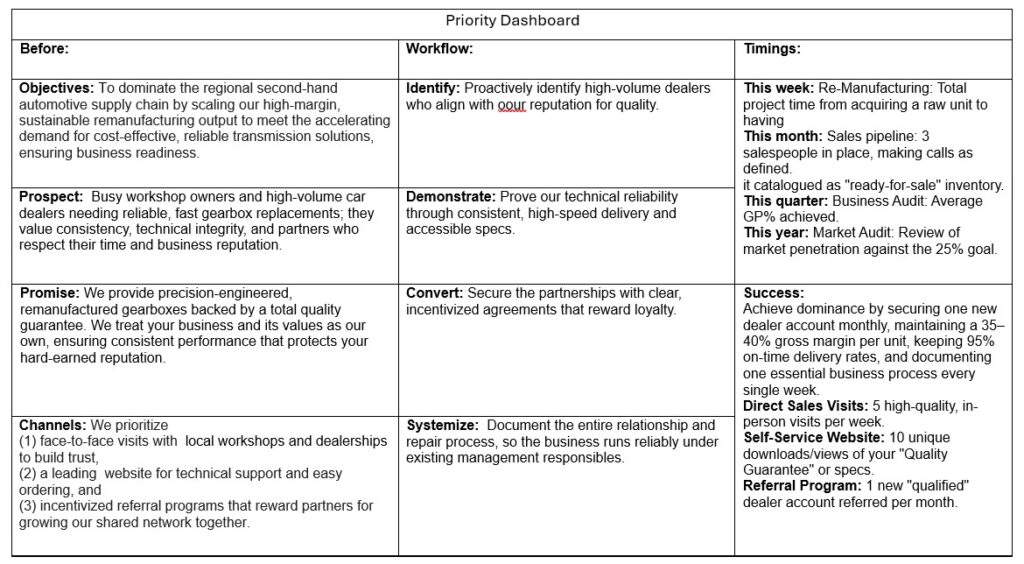
The importance of communicating departmental objectives in a SME to all staff
In a large company, a “Director of Finance” knows exactly what their load is because it’s in their job description. In your SME, that clarity is often missing, so the owner ends up carrying the entire load by default. When you document these departmental responsibilities—whether it’s managing the cash flow, maintaining the IT infrastructure, or ensuring client success—you are effectively defining the “load” for everyone. By making these responsibilities visible in your Master Schematic, your team no longer needs you to tell them what to do; they can see for themselves exactly what they are accountable for. This transparency ensures that everyone knows exactly what their share of the load is, and more importantly, they understand that their daily checklist is the only thing keeping the business on track. When the load is distributed and clearly mapped, the owner stops being the only one holding the business up, and the team starts operating with the same focus and accountability found in a major corporation.
Stop Supervising, Start Architecting
The difference between a founder who is trapped in the daily grind and one who is building a lasting asset is a system. You have the vision, the experience, and the wisdom to drive your business forward; however, until those objectives are mapped, documented, and shared, they remain theoretical burdens living only in your head. Whether you are seeking investment, scaling, or focusing on consolidation, your success depends on moving from verbal supervision to a visible, shared schematic. You do not need a 40-page theoretical plan that gathers dust; you need a single-page Master Schematic that acts as the dashboard for your daily operations. Download the A3 Master Schematic below, map out your objectives and departmental responsibilities, and use it to see exactly where your system is currently leaking. Once you have it in front of you, book your 15-Minute Diagnostic Audit—let’s review your schematic together and turn your vision into a predictable, high-performance asset.
About Small Business Marketing
Small Business Marketing is led by Garth Sutherland who has an extensive multicultural marketing understanding.
He has worked with local brands (creating independent strategic positions) and international brands (integrating the international brand vision with the local demand to optimize the “on the ground” brand presence). His strengths include bringing a strong strategic focus into all aspects of marketing delivery, working with multi-agency perspectives, independent thinking & implementing with a consistent and practical teamwork focused delivery.
If the insights shared in this article (and others at www.smallbusinessmarketing.co.za) resonate with you and highlight a solution that would add tangible value to your business, then you’re in the right place. As a fractional marketing consultant, Garth doesn’t just develop actionable marketing plans; crucially he manages their execution. This frees you up to build your business.
Are you ready to achieve your personal and business goals, and reclaim your valuable time? SmallBusinessMarketing is the ideal resource to task.
You can contact Garth at smallbusinessmarketing.co.za on +971 (0) 81265 5803 or at garthsbm@gmail.com
Email: garth@smallbusinessmarketing.co.za
Call: +27 (0) 81 265 5803
Web: https://www.smallbusinessmarketing.co.za/
LinkedIn Personal Profile: https://www.linkedin.com/in/garthrsutherland/
Leave a Reply